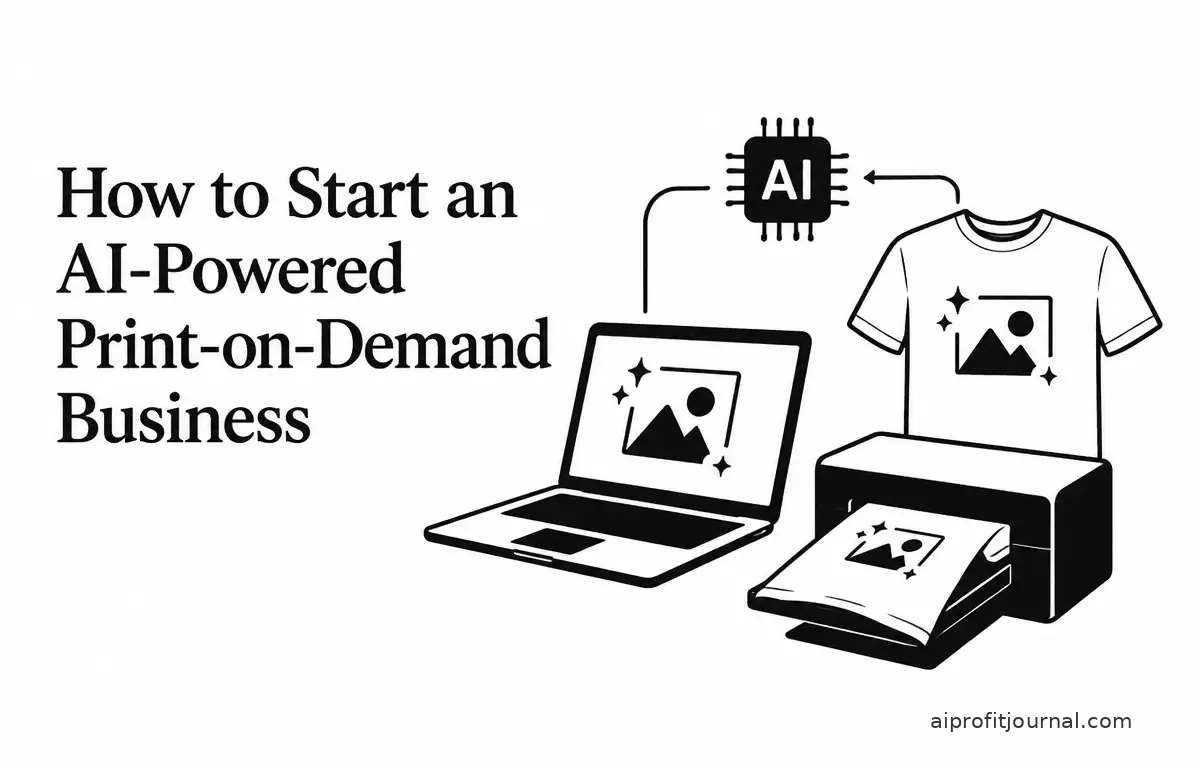
Starting a print-on-demand business with AI can make parts of product creation and marketing more accessible. Instead of managing inventory or purchasing products in advance, sellers can work with a fulfillment provider that produces items after customers place orders.
AI tools can support several parts of this process, including design brainstorming, product descriptions, market research, and content planning. However, using AI does not automatically create a profitable business. Product quality, customer demand, pricing, marketing, and fulfillment still determine whether an online store can become sustainable.
This guide explains how to approach an AI-assisted print-on-demand business, which tools may help, how to estimate costs, and what beginners should consider before launching.
What Is an AI-Powered Print-on-Demand Business?
Print-on-demand (POD) is an e-commerce model in which products are manufactured after a customer places an order. Depending on the provider, products may include T-shirts, hoodies, mugs, posters, tote bags, phone cases, and other customizable items.
Unlike traditional retail, sellers generally do not need to purchase large quantities of inventory before making their first sale.
A typical workflow looks like this:
- Choose a product category and target audience.
- Develop an original design concept.
- Prepare the design file and product mockups.
- Publish the product listing in an online store.
- Receive an order from a customer.
- Send the order to a print-on-demand provider.
- The provider produces and ships the item.
AI can assist with selected activities in this process, but it does not replace the need for product decisions, quality control, customer service, or business management.
For example, an AI image generator may help develop visual concepts, while a writing assistant can help prepare product descriptions. The seller remains responsible for reviewing the final material and ensuring that it is accurate and suitable for commercial use.
1. Choose a Specific Niche Before Creating Products
One of the most common mistakes in print-on-demand is trying to sell products to everyone.
A store with a clear audience is generally easier to position than a store containing unrelated designs across dozens of categories.
Consider starting with a specific customer group or interest, such as:
- Outdoor and hiking enthusiasts
- Pet owners
- Home office and remote work communities
- Fitness and recreational sports
- Gardening and plant enthusiasts
- Personalized gifts for particular occasions
AI research tools can help organize possible niche ideas, generate customer questions, and identify topics worth investigating.
However, AI-generated suggestions should be treated as starting points rather than proof of market demand.
Before committing to a niche, examine:
- Existing products and competing stores
- Customer reviews and frequently mentioned complaints
- Typical product prices
- Seasonal demand
- Design styles already common in the market
- Opportunities to create something meaningfully different
Google Trends and marketplace search results can provide useful signals, but neither guarantees that a product will sell.
A niche should be selected based on a combination of customer interest, competition, product suitability, and your ability to create something valuable.
2. Use AI to Develop Original Product Designs
AI image-generation tools can help sellers explore visual concepts without beginning every design from a blank page.
For example, a seller targeting hiking enthusiasts might explore concepts involving mountain landscapes, camping illustrations, trail-themed typography, or minimalist outdoor graphics.
An AI-assisted design workflow may include:
- Define the target customer and product concept.
- Generate several visual directions.
- Select the most relevant concept.
- Refine the composition and typography.
- Check image resolution and print specifications.
- Prepare the final file for the selected product.
Some tools worth researching include:
- Adobe Firefly: Generative image and design capabilities for creative workflows.
- Canva: Design and layout tools that can help prepare product graphics and promotional materials.
- Midjourney: AI image generation for exploring visual concepts and artistic directions.
The availability of commercial-use rights, licensing conditions, and feature restrictions depends on each provider’s current terms and subscription plan. Review those terms before using generated assets in products for sale.
AI-generated images also need human review. Common problems include distorted details, inconsistent lettering, unwanted visual elements, and compositions that do not work well when printed on physical products.
A design that looks attractive on a computer screen may not produce a good result on a T-shirt or mug.
For that reason, inspect the actual print dimensions, background, contrast, and product mockup before publishing a listing.
3. Select a Print-on-Demand Fulfillment Provider
A print-on-demand provider handles production and, depending on the service, packaging and shipping.
One established option is Printful. Its fulfillment model allows sellers to connect products with an online store and have items produced when orders arrive.
Other providers may offer different product catalogs, production locations, integrations, and pricing structures.
When comparing providers, examine the following factors:
Product selection
Check whether the provider offers the products that fit your niche. A store focused on apparel may have different requirements from one selling wall art or personalized accessories.
Base product costs
The base cost is important because it directly affects the amount remaining after each sale.
Shipping
Compare shipping charges, estimated delivery times, and available fulfillment locations for your target market.
Print quality
Look at product specifications and, when possible, order samples before selling products to customers.
Store integrations
Check whether the provider supports your chosen e-commerce platform and how orders, product variants, and tracking information are synchronized.
A useful starting point is the official Printful guide explaining how its print-on-demand service works.
Remember that a provider handling production does not mean the seller has no operational responsibilities. Customer communication, refunds, product selection, listing accuracy, and store management still matter.
4. Build an Online Store and Prepare Product Listings
After choosing a niche, preparing designs, and selecting a fulfillment provider, the next step is creating an online storefront.
Common options include:
- Shopify: An e-commerce platform for building and managing an independent online store.
- Etsy: A marketplace with specific requirements for original designs, production partners, and AI-assisted creations.
- WooCommerce: A WordPress-based e-commerce solution that provides flexibility for store owners who want to manage their own website.
The best option depends on your budget, technical requirements, preferred sales channels, and ability to attract customers.
Product listings should clearly explain what customers are purchasing.
A useful product listing generally includes:
- A descriptive product title
- Accurate product specifications
- Available sizes, colors, and variations
- Clear product photographs or mockups
- Shipping and production information
- Relevant search terms
- A transparent return and customer service policy
AI writing assistants can help generate initial product description drafts, but those drafts should be checked against the actual product specifications.
Do not allow AI to invent material types, dimensions, quality claims, or product features.
If a product is made and shipped by a third-party production partner, describe the arrangement accurately.
5. Understand Marketplace Rules for AI-Generated Designs
Marketplace policies are an important part of an AI-assisted POD business.
For example, Etsy allows certain seller-prompted AI creations, but its policies require sellers to disclose the use of AI in relevant listings.
Etsy also requires sellers to maintain a meaningful creative role. Fully automated, bot-generated listings without individualized human involvement are not permitted.
Its rules also address intellectual property, production partners, and the accuracy of listing images.
Before listing AI-assisted designs, review:
These policies can change, so sellers should check the latest requirements rather than relying on older tutorials.
Copyright and trademark considerations also matter. Avoid designs that use protected logos, recognizable characters, brand names, or copyrighted artwork without the necessary permission.
An AI image generator producing a particular visual does not automatically mean that the result is free from intellectual property concerns.
6. Calculate Costs and Potential Profit
A print-on-demand business may have lower inventory requirements than traditional retail, but it still involves costs.
Potential expenses include:
- Base product and printing costs
- Shipping charges
- Marketplace or payment processing fees
- E-commerce platform subscriptions
- Design software subscriptions
- Advertising and promotion
- Refunds, replacements, and other operational costs
A simple way to estimate the financial outcome is:
Estimated profit per order = Selling price − Product cost − Shipping cost − Selling fees − Other variable costs
Consider a hypothetical example:
| Item | Illustrative amount |
|---|---|
| Selling price | $25.00 |
| Base product and printing | $10.00 |
| Shipping | $4.00 |
| Marketplace and payment fees | $2.00 |
| Other variable costs | $1.00 |
| Estimated amount remaining | $8.00 |
This example is only an illustration. Actual fees and costs depend on the provider, marketplace, destination, product, and transaction.
It also excludes some potential business expenses, including taxes, fixed subscriptions, and advertising.
A product with an attractive selling price may still have a narrow margin after all costs are included.
Before setting prices, calculate the full cost structure and consider whether the remaining amount justifies the time and effort required to operate the store.
7. Use AI to Support Marketing and Customer Communication
Marketing is necessary because publishing products does not guarantee that customers will discover them.
AI tools can help prepare and organize marketing activities, including:
Product content
Generate initial drafts for product descriptions, promotional messages, and social media captions.
Content planning
Develop a content calendar around relevant topics, product use cases, and seasonal opportunities.
Search optimization
Organize keyword ideas and identify relevant phrases that customers may use when searching for products.
Customer support drafts
Prepare responses to common questions about product specifications, sizing, shipping, and order processes.
However, AI-generated marketing content should be reviewed before publication.
Avoid misleading product claims, fabricated customer testimonials, fake reviews, and artificial scarcity.
For customer service, make sure that responses accurately reflect the provider’s actual production and shipping policies. Important issues such as refunds, damaged products, and order disputes may require direct human attention.
8. Common Challenges of AI-Assisted Print-on-Demand
Using AI can make some activities more accessible, but it does not remove the underlying challenges of running an e-commerce business.
High competition
Many sellers can create AI-assisted designs quickly. Generic graphics may therefore struggle to stand out.
Uncertain demand
A visually appealing design does not prove that customers want to purchase it. Market research and customer feedback remain important.
Product quality
Digital mockups cannot fully demonstrate the quality of a physical product. Samples and supplier specifications can help reduce uncertainty.
Intellectual property risks
AI-generated designs may unintentionally resemble protected material. Sellers need to review their designs and avoid unauthorized use of third-party intellectual property.
Marketing costs
Generating traffic may require time, content development, marketplace optimization, or paid advertising.
Operational responsibilities
Even when production and shipping are outsourced, the seller remains responsible for the overall customer experience.
Understanding these limitations is more useful than assuming that AI can automatically turn a product idea into a profitable store.
A Practical Starting Checklist
For beginners who want to explore this business model, the following sequence can help organize the work:
- Select one niche and define the intended customer.
- Research competing products and customer needs.
- Develop a small collection of original design concepts.
- Review licensing and commercial-use conditions for the tools involved.
- Compare print-on-demand providers and product costs.
- Prepare accurate product listings.
- Calculate selling prices and potential margins.
- Review marketplace rules and fulfillment arrangements.
- Publish a manageable initial product selection.
- Monitor customer interest, costs, and feedback before expanding.
There is no need to launch hundreds of designs immediately. A smaller collection can make it easier to review quality, organize listings, and understand which products deserve further attention.
Frequently Asked Questions
Can beginners start a print-on-demand business with AI?
Yes. AI tools can support design brainstorming, content preparation, and marketing tasks. However, beginners still need to understand their target audience, review product quality, manage costs, and provide customer service.
Do I need inventory for a print-on-demand business?
Generally, no. Print-on-demand providers produce items after customers place orders. However, sellers may still choose to purchase samples to inspect product quality before listing items.
Can AI-generated designs be sold on Etsy?
Certain seller-prompted AI creations are allowed under Etsy’s policies. Sellers must disclose AI use where required, maintain a meaningful creative role, and comply with the marketplace’s other rules.
Is an AI-powered print-on-demand business profitable?
Profitability is not guaranteed. Results depend on product demand, competition, pricing, fulfillment costs, marketing, and customer satisfaction.
Which AI tools can help with print-on-demand?
Image-generation and design tools such as Adobe Firefly, Midjourney, and Canva may support different parts of the creative workflow. Their features, terms, and commercial-use conditions should be reviewed before use.
What is the biggest mistake beginners should avoid?
Creating large numbers of generic designs without researching customer demand. A smaller collection of relevant, carefully reviewed products is often a more manageable starting point.
Final Thoughts
An AI-powered print-on-demand business combines digital design tools with outsourced product fulfillment. AI can support creative work, research, product descriptions, and marketing, but it cannot guarantee demand or replace good business decisions.
The most sensible approach is to start with a clearly defined audience, develop original designs, understand the full cost structure, and follow the rules of the selected marketplace.
Treat AI as a tool that supports the business process—not as a shortcut to guaranteed income.