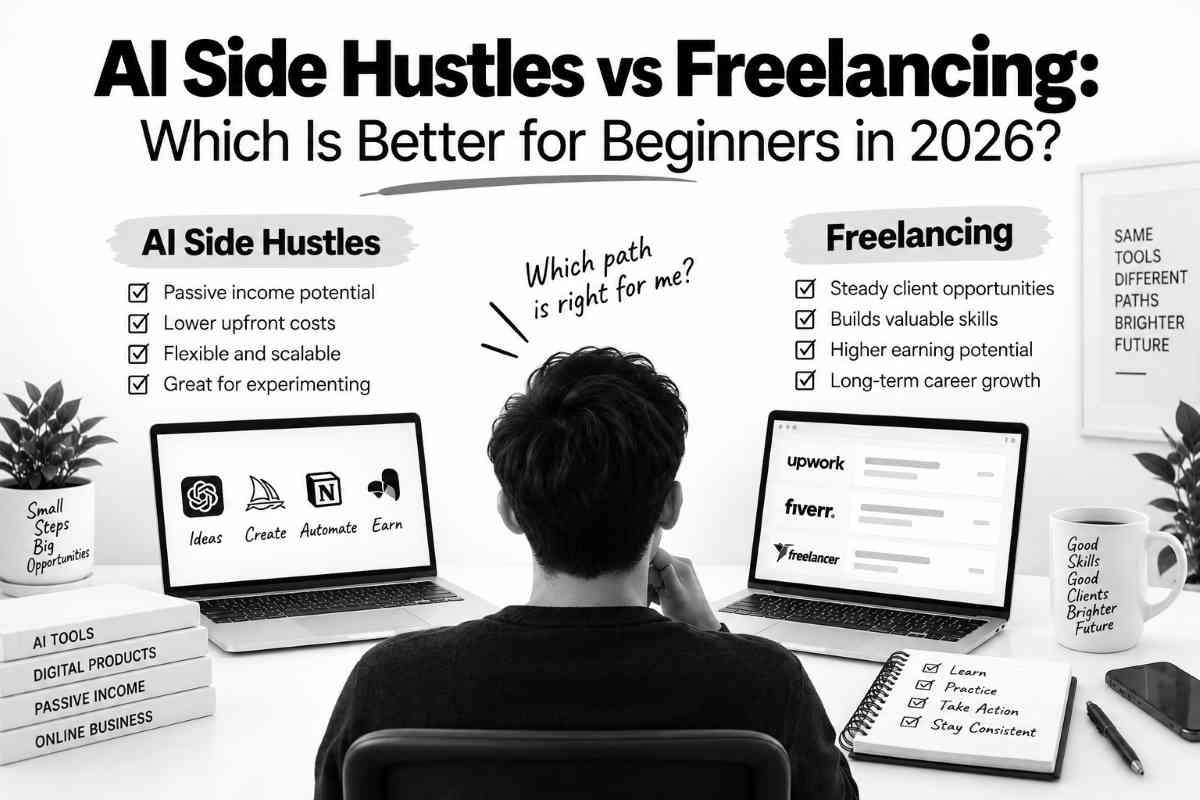
If you’re trying to make money online in 2026, you’ve probably come across two ideas again and again:
AI side hustles.
And freelancing.
At first glance, they can look like two completely different paths.
A side hustle sounds like something you build on the side, perhaps using AI tools to create products, content, automation, or other income streams.
Freelancing sounds more straightforward: learn a skill, offer it to clients, complete projects, and get paid.
But there’s a lot of overlap now.
A freelancer can use AI to work faster.
An AI side hustle can involve selling a service.
And someone can start freelancing as a side hustle before eventually turning it into a full-time business.
So which path makes more sense for a beginner in 2026?
There isn’t one answer that applies to everyone.
Instead, it helps to understand what each model actually involves, where AI changes the equation, and what you’re realistically signing up for.
AI Side Hustles vs Freelancing: What’s the Difference?
Let’s start with the basic definitions.
What Is an AI Side Hustle?
An AI side hustle is an income-generating activity where artificial intelligence plays an important role in creating, delivering, marketing, or automating the work.
Examples might include:
- Creating digital products with AI assistance
- AI-assisted content creation
- AI-powered design services
- AI automation services
- AI-assisted research
- Building small AI-powered tools
- Creating educational resources
- AI-assisted affiliate content
- Producing marketing assets
- Offering specialized AI workflows
The important thing is that AI is part of the business model or workflow.
It doesn’t necessarily mean the business runs automatically.
That’s a common misconception.
An “AI side hustle” can still involve plenty of human work.
What Is Freelancing?
Freelancing is selling your skills or services directly to clients rather than working as a traditional employee.
Common freelance services include:
- Writing
- Graphic design
- Video editing
- Web development
- SEO
- Virtual assistance
- Marketing
- Research
- Data work
- Consulting
- Automation
AI can now be part of almost all of these services.
That’s one of the biggest changes compared with a few years ago.
The Line Between AI Side Hustles and Freelancing Is Blurring
This is worth understanding before comparing the two.
Imagine someone offers businesses an AI-assisted content service.
They use AI to:
- Research topics
- Create outlines
- Draft material
- Generate variations
- Organize content
Then they personally edit everything and deliver the final work to a client.
Is that an AI side hustle?
Is it freelancing?
Honestly, it can be both.
The distinction is often more about the business model than the technology.
Freelancing generally means you’re being paid by a client for a defined service.
A side hustle can include freelancing, but it can also involve products, audiences, affiliate income, subscriptions, or other models.
That’s why I wouldn’t treat them as completely separate categories.
What Has Changed in 2026?
AI is increasingly becoming part of ordinary freelance work rather than existing as a separate category.
For example, Upwork’s 2026 research found that the skills most explicitly tied to applying AI within existing roles grew 109% year over year, with growth across areas such as AI video generation/editing, AI integration, data annotation, and chatbot development.
More recent Upwork data points in the same direction: clients are moving from simply experimenting with AI toward hiring people to actually implement AI in products, workflows, and business systems. In June 2026, AI Apps & Integration was its strongest overall growth category, rising 34% month over month and 33% year over year on its marketplace.
That suggests something important for beginners:
Knowing how to use an AI tool is becoming less distinctive. Knowing how to use it to solve a real problem is becoming more important.
AI Side Hustles: How They Work
There are many different models, so it’s useful to separate them.
1. Digital Products
You might use AI to help create:
- Templates
- Guides
- Checklists
- Workbooks
- Spreadsheets
- Prompt libraries
- Educational resources
The appeal is that you can potentially sell the same product multiple times.
But there’s a catch.
Creating the product may be the easy part.
Finding people who want it can be much harder.
That’s something I explored in my own article about using AI to build a digital product.
2. AI-Assisted Services
This is where the distinction with freelancing becomes very blurry.
You could use AI to help deliver:
- Content
- Social media assets
- Research
- Video
- Design
- Marketing materials
- Data processing
- Automation
The customer pays for the outcome, not necessarily the AI tool.
3. AI Automation
You might build workflows that reduce repetitive tasks for businesses.
For example:
- Lead processing
- Customer support workflows
- Data organization
- Reporting
- Email workflows
- Content workflows
- Document processing
This can require more technical knowledge, but the underlying concept is simple:
Use AI and automation to solve an expensive or repetitive business problem.
4. Content-Based Businesses
AI can help with:
- Blog research
- Outlines
- Drafting
- Editing
- Social media
- Video scripts
- Newsletters
But building an audience is still the difficult part.
AI can make content production faster.
It doesn’t automatically create attention.
Freelancing: How It Works
The traditional freelance model is more straightforward.
You have a skill.
You find someone who needs that skill.
You offer a service.
You complete the work.
You get paid.
The process might look like:
Skill → Portfolio → Offer → Client → Project → Payment
AI can now be inserted into almost every stage.
For example:
Writing → AI-assisted writing → faster delivery
or:
Research → AI-assisted research → faster analysis
or:
Video editing → AI-assisted editing → more output
That creates an interesting opportunity.
You don’t necessarily need to build an entirely new AI business.
You can take an existing skill and use AI to make your workflow more efficient.
The Biggest Difference: Who Pays You?
This is one of the simplest ways to understand the two models.
With freelancing, a client generally pays you directly for work or an outcome.
With a product-based side hustle, the customer buys something you’ve created.
With content, an audience may eventually generate revenue through advertising, affiliate relationships, sponsorships, products, or services.
Those are different relationships.
And each has different challenges.
Startup Cost Comparison
One reason beginners are attracted to AI side hustles is the perception that they are almost free.
Sometimes they can be started cheaply.
You may only need:
- An AI tool
- A computer
- Internet access
- A platform to distribute your work
But “low startup cost” doesn’t mean “no cost.”
You may eventually spend money on:
- AI subscriptions
- Website hosting
- Software
- Design tools
- Marketplace fees
- Payment processing
- Advertising
- Automation platforms
Freelancing can also be started with relatively little capital.
You may need a portfolio, software, internet access, and potentially platform fees or proposal credits depending on where you find clients.
The actual cost varies considerably by service and platform.
Which Requires More Skill?
This is where the comparison gets interesting.
An AI side hustle might appear easier because AI handles some of the production.
But that doesn’t necessarily mean the business requires fewer skills.
Consider an AI automation service.
You may need to understand:
- AI models
- APIs
- Automation platforms
- Business workflows
- Data
- Client requirements
- Testing
- Troubleshooting
That’s not exactly beginner-level work.
On the other hand, a beginner could potentially start freelancing with a skill they already have.
For example, someone who is already good at writing might use AI to increase their productivity without having to learn an entirely new technical stack.
What Does the 2026 Freelance Market Tell Us?
Current marketplace data provides an interesting signal.
Upwork’s 2026 Future Workforce Index reports that skilled freelancers doing AI-related work earned 34% more per hour than freelancers not incorporating AI, based on its marketplace data. But the same research found that not all AI work was becoming more valuable: generative AI and creative production contract starts grew 90% year over year while per-contract earnings fell 13%.
The implication isn’t that “AI freelancing pays more.”
That’s too broad.
The data suggests that different types of AI-related work are behaving differently.
More complex AI-augmented professional work has been growing in value, while some lower-complexity execution work faces pressure as it becomes easier to produce at scale.
That’s a useful distinction for beginners.
Simply knowing how to ask an AI chatbot to produce something may not be a durable competitive advantage.
Being able to understand a client’s problem and use AI as part of a reliable solution is a different skill.
AI Side Hustles vs Freelancing: A Practical Comparison
Here’s a simple way to compare them.
| Factor | AI Side Hustle | Freelancing |
|---|---|---|
| Starting point | Idea or opportunity | Existing skill/service |
| Main customer | Consumers, businesses, or audience | Usually a client |
| Income model | Products, services, content, affiliates, etc. | Client payments |
| AI dependence | Can be central | Usually supportive |
| Upfront cost | Often low, but varies | Often low, but varies |
| Need for clients | Not always | Usually yes |
| Need for audience | Sometimes | Not necessarily |
| Income timing | Can take time to develop | Can begin after landing clients |
| Scalability | Depends on model | Often tied to capacity unless productized |
| Skill requirements | Vary widely | Usually clearer |
| Relationship | Customer/audience | Client |
| Main challenge | Finding demand | Finding and retaining clients |
This isn’t a ranking.
They’re simply different ways of structuring work.
What About Time?
This is another important difference.
Freelancing can produce relatively direct income because you’re exchanging work for money.
If a client hires you for a project, completing that project can produce revenue.
A product-based side hustle may work differently.
You might spend considerable time creating something before making the first sale.
For example:
Research → Build → Publish → Market → Wait → Improve
That can eventually become more scalable.
But the initial phase may involve more uncertainty.
This is why beginners should be careful about comparing a freelance hourly rate with a theoretical passive-income number.
They are different economic models.
Which Has Faster Feedback?
Freelancing usually provides a very direct form of feedback.
A client either:
- Responds
- Asks for changes
- Accepts the proposal
- Rejects the proposal
- Pays
- Doesn’t hire you
That’s useful information.
A product business can have slower feedback.
You might publish something and get very little response.
Was the product bad?
Was the marketing weak?
Was the audience too small?
Was the price wrong?
Was the product difficult to find?
There are more variables.
That can make early experimentation harder to interpret.
The Argument for Starting With Freelancing
For some beginners, freelancing can be a practical way to turn an existing skill into income.
You don’t necessarily need to build an audience first.
You don’t necessarily need to create a product.
And you can learn directly from clients.
For example, suppose you’re a beginner at using AI for marketing.
Instead of immediately building an AI marketing course, you could offer a small marketing service.
That gives you an opportunity to discover:
- What businesses actually need
- Which tasks take the most time
- What clients are willing to pay for
- What results matter
- Which parts can be improved with AI
That real-world information can later become the foundation for a product or specialized service.
The Argument for Starting With an AI Side Hustle
The opposite approach can also make sense.
If you have a good product idea, audience, or niche knowledge, building something that isn’t tied directly to your hours may be attractive.
Digital products are an obvious example.
Instead of:
1 hour of work → 1 hour of revenue potential
you may be building:
Product creation → distribution → multiple potential customers
That doesn’t mean the second model is automatically better.
It simply has a different scaling structure.
The difficult part is getting people to buy.
The Hybrid Approach
This is probably the part I’d pay the most attention to.
You don’t necessarily have to choose one forever.
A beginner could start with freelancing and use AI to improve delivery.
Then identify recurring client problems.
Then turn one of those solutions into a product.
For example:
Freelance writing
↓
Discover that clients repeatedly need content briefs
↓
Create an AI-assisted content brief service
↓
Turn the workflow into a template
↓
Sell the template as a digital product
↓
Potentially create a larger service or product around it
This creates a bridge between freelancing and side hustles.
Your client work becomes research.
Your research becomes a product.
Your AI workflow becomes part of the competitive advantage.
What Skills Are Becoming More Valuable?
One interesting trend in 2026 is that the market appears to be moving toward AI + existing expertise, rather than AI as a standalone skill.
Upwork’s 2026 research describes an emerging type of worker who combines AI fluency with domain expertise, workflow design, judgment, and business impact.
That makes intuitive sense.
Imagine two freelancers.
Person A knows how to generate AI images.
Person B understands ecommerce marketing and uses AI image generation to produce and test product creatives.
The technology may be similar.
The business value isn’t.
That distinction is increasingly important.
AI Skills Alone May Not Be Enough
There’s a temptation to think:
“I’ll just learn AI.”
But AI isn’t one skill.
And businesses generally don’t pay simply because someone knows how to open an AI chatbot.
They pay for outcomes.
That’s why useful combinations might look like:
- AI + copywriting
- AI + video editing
- AI + SEO
- AI + web development
- AI + marketing
- AI + data analysis
- AI + customer support
- AI + automation
- AI + design
The second skill gives the AI capability a context.
What About AI Content Creation?
Content creation is one of the easiest places for beginners to experiment with AI.
But it is also becoming increasingly competitive.
Recent marketplace data illustrates this shift. Upwork reported that AI-related creative searches are becoming more specific, with clients moving from broad searches toward specific outputs such as AI UGC, AI animation, AI video generation, and AI video ads.
Fiverr’s 2026 business trends similarly reported strong growth in AI-related creative demand, while also showing continued growth in human video-editing services.
That suggests an important lesson:
Don’t just sell “AI.” Sell a useful result.
“AI content creator” is vague.
“Short-form product videos for ecommerce brands” is much clearer.
Common Mistakes Beginners Make
Mistake 1: Choosing the Most Exciting Idea
The coolest AI business isn’t necessarily the most practical one for you.
Look at your existing skills first.
Mistake 2: Buying Too Many Tools
You don’t need ten subscriptions to test one business idea.
Start with the smallest workable setup.
Mistake 3: Confusing AI Skills With Business Skills
Knowing how to use AI doesn’t automatically teach you sales, positioning, customer research, or delivery.
Mistake 4: Expecting Passive Income Immediately
Most side hustles require work before they become easier to maintain.
Mistake 5: Selling Generic AI Output
If everyone can generate roughly the same output, differentiation becomes difficult.
Add expertise, judgment, customization, or a specific business outcome.
Mistake 6: Ignoring Distribution
Creating something isn’t enough.
People need to find it.
How to Choose Your Starting Point
Instead of asking:
“Which is better?”
I’d ask five questions.
1. Do I already have a marketable skill?
If yes, freelancing may give you a straightforward starting point.
2. Do I already have an audience?
If yes, a product or content-based side hustle may be worth exploring.
3. Do I enjoy working with clients?
If you don’t, a client-based business may become frustrating.
4. Do I want immediate feedback?
Client work usually provides faster feedback than building an audience or product.
5. Do I want to eventually build something less tied to my time?
A product, audience, or software-based model may offer more possibilities for decoupling revenue from hours worked, although reaching that point can take substantial effort.
These aren’t rules.
They’re simply useful questions to ask before committing to a direction.
A Beginner-Friendly 30-Day Approach
If you’re completely stuck, you don’t need to decide your entire career.
Run a small experiment.
Week 1: Pick One Skill
Choose something you can already do reasonably well.
Writing.
Design.
Video.
Research.
Marketing.
Spreadsheets.
Coding.
Week 2: Add AI
Find one part of the workflow where AI can reduce repetitive work.
Don’t automate everything.
Just one part.
Week 3: Create an Offer
Turn the skill into a specific service.
Instead of:
“I do AI.”
Try something like:
“I create short-form product videos for small ecommerce brands.”
The second statement tells a potential customer what they are actually buying.
Week 4: Test Demand
Talk to potential customers.
Send proposals.
Publish an example.
Ask for feedback.
See what happens.
You don’t need a perfect business plan.
You need information.
So, AI Side Hustles or Freelancing?
The answer depends on what you’re starting with.
If you already have a useful skill and want to start earning from that skill, freelancing can provide a relatively direct model.
If you have a product idea, audience, or strong niche knowledge, an AI-assisted side hustle may give you another path.
And there’s nothing stopping you from combining the two.
In fact, AI makes that combination particularly interesting.
You can freelance to understand a market.
Use AI to improve your workflow.
Identify recurring problems.
Then turn those problems into products, systems, or specialized services.
That’s a much more grounded way to think about making money with AI in 2026.
Final Thoughts
The biggest change isn’t that AI created a completely new category of work.
It’s that AI is becoming part of how existing work gets done.
The 2026 freelance data points toward growing demand for people who can combine AI with practical skills and business outcomes. At the same time, some lower-complexity AI execution work is becoming easier to produce at scale, putting pressure on its economics.
For beginners, that creates an interesting opportunity—but also a warning.
Don’t build your entire plan around knowing how to use an AI tool.
Learn something useful.
Find a real problem.
Use AI to solve that problem faster or better.
Then pay attention to what customers actually value.
Whether you call that freelancing, an AI side hustle, or simply a small online business isn’t nearly as important as the result you’re able to create.
Frequently Asked Questions
Is freelancing better than an AI side hustle for beginners?
There isn’t one option that’s better for every beginner.
Freelancing may be a more direct starting point for someone who already has a marketable skill and wants to sell that skill to clients.
An AI side hustle may make more sense for someone who has a product idea, audience, niche knowledge, or interest in building something beyond direct client work.
Can freelancing be an AI side hustle?
Yes.
A freelance service can use AI extensively while still being a freelance business.
For example, someone might offer content, design, research, video, marketing, or automation services while using AI to improve their workflow.
Can you make money with AI without freelancing?
Yes.
Potential models include digital products, content businesses, affiliate marketing, software, automation, education, and other businesses where AI is part of the workflow.
However, each model still requires some combination of demand, distribution, skills, and execution.
Is AI making freelancing harder?
AI is changing freelance work rather than affecting every freelance service in the same way.
Some low-complexity tasks can become easier and cheaper to produce, which can increase competition and put pressure on pricing.
At the same time, businesses are hiring freelancers for AI implementation, integration, creative production, and more complex AI-augmented work.
What AI skills should beginners learn?
Rather than learning AI as an isolated skill, consider combining it with something useful.
Examples include:
- AI + writing
- AI + marketing
- AI + design
- AI + video
- AI + automation
- AI + data analysis
- AI + web development
The combination gives the technology a practical context.
Do I need coding skills to make money with AI?
No.
There are many non-coding ways to use AI, including writing, research, design, video, marketing, customer support, and administrative workflows.
Coding can open additional opportunities, particularly in automation and software, but it isn’t a requirement for every AI-related business.
How much money can a beginner make with AI freelancing?
There isn’t a reliable universal figure.
Income depends on the service, skill level, market, client demand, pricing, hours available, and ability to win and retain clients.
It’s better to treat income claims as examples rather than guarantees.
Should I start with freelancing or build a digital product?
Think about what you already have.
If you have a skill but no audience, freelancing can let you sell that skill directly.
If you have a strong audience or understand a specific problem deeply, a digital product may be worth testing.
You can also use freelance work to discover problems that later become product opportunities.
Related AIProfitJournal Articles
If you’re exploring AI income opportunities, these articles may also be useful:
- 30 Days Using AI to Make Money – What Happened – A practical experiment testing different AI income ideas.
- I Used AI to Build a Digital Product: What I Learned From the Process – Lessons from using AI throughout the digital-product creation process.
- AI Content Creation for Beginners: A Practical Workflow – A step-by-step workflow for using AI in content creation.
One Final Thought
You don’t have to choose between “AI” and “freelancing.”
The more interesting question is:
What useful skill can I combine with AI?
That question leads to better experiments.
And it gives you more options than simply chasing the latest AI side-hustle trend.