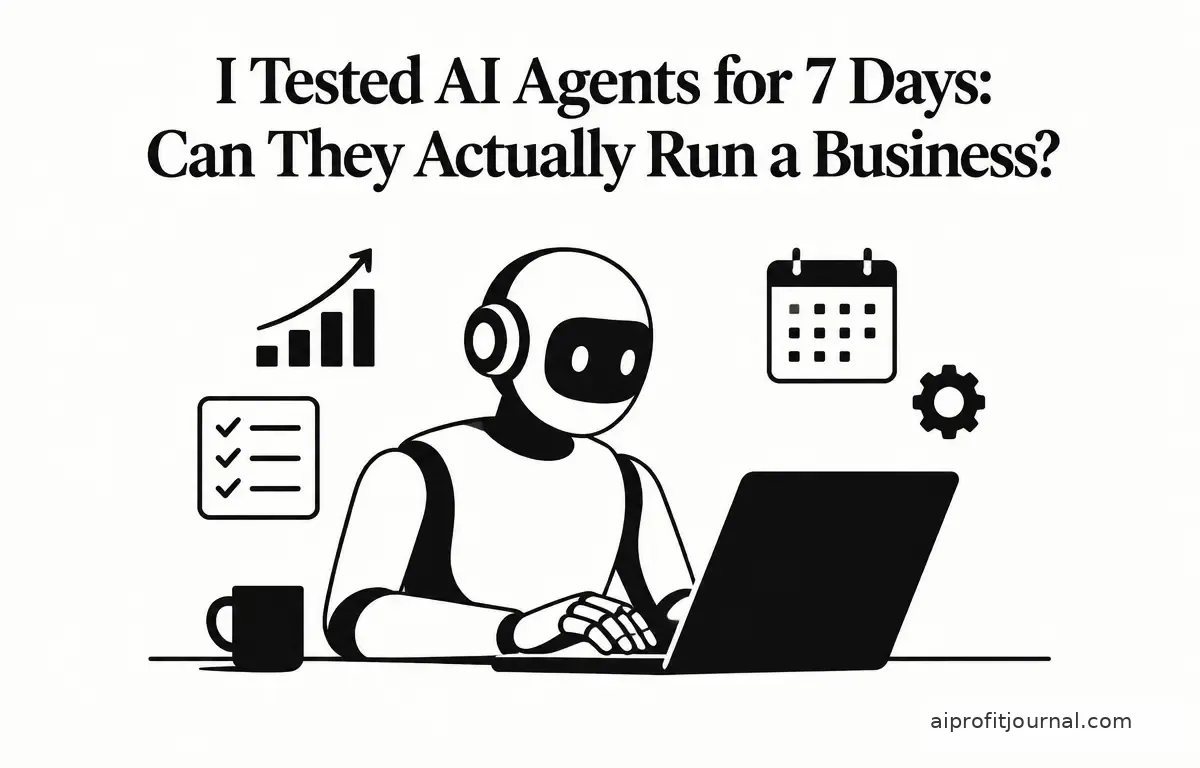
In recent years, AI agents have emerged as promising tools for automating various business processes, from customer service to financial management. But can they truly handle the complexities of running a business? To answer this question, I embarked on a comprehensive 7-day test, integrating AI agents into key operational areas of a small enterprise.
Understanding AI Agents in Business Operations
AI agents are autonomous software systems designed to perform tasks without human intervention. In the realm of business operations, they can manage workflows, analyze data, and make decisions based on predefined criteria. Companies such as IBM are pioneering AI agents tailored for enterprise applications, capable of automating functions like HR support, sales qualification, and procurement. These agents use algorithms to learn from data, making them adaptable to various tasks. For instance, a smart AI-driven CRM system could analyze customer interactions and predict future buying behavior, allowing businesses to tailor their marketing strategies effectively. In practice, this means that small enterprises can personalize their customer interactions, making them feel more valued and understood.
Setting Up the Test Environment
For my experiment, I selected a suite of AI agents known for their versatility and integration capabilities. The chosen agents were configured to manage key business functions:
- Customer Relationship Management (CRM): Automating lead capture, follow-ups, and pipeline management.
- Accounting: Processing invoices, reconciling accounts, and generating financial reports.
- Project Management: Assigning tasks, tracking progress, and ensuring deadlines are met.
- Human Resources (HR): Managing employee records, scheduling interviews, and handling onboarding processes.
The selection process for these agents involved assessing their integration capabilities with existing tools, scalability, and the potential for enhancing efficiency. It was crucial to choose agents that could communicate with our existing software ecosystems to ensure seamless integration and minimize disruptions. This holistic view of the software landscape emphasized the importance of compatibility among different business applications.
Day 1: Integration and Configuration
The initial setup involved integrating the AI agents with existing business tools, including the CRM system, accounting software, project management platform, and HR management system. This integration process was relatively straightforward, thanks to the agents’ compatibility with widely used business applications. However, ensuring a seamless data flow between systems required meticulous configuration to prevent potential errors. During this phase, careful attention was paid to mapping data fields so that information would transfer accurately between platforms.
To illustrate, for the CRM integration, I ensured that any new lead captured from social media channels was automatically directed to the sales pipeline without manual intervention. This involved creating rules for categorization based on the lead’s source and behavior, helping prioritize which leads to follow up on first. Furthermore, setting up variable triggers allowed the AI to flag high-value leads that might need immediate human attention, creating a balance between automation and personal oversight.
Days 2-3: CRM Automation
On Days 2 and 3, the AI agents automating lead capture began processing inquiries from various channels, including the website and social media platforms. They effectively categorized leads based on predefined criteria, initiated tailored follow-up sequences, and maintained customer interactions. Although the agents efficiently handled routine inquiries, they occasionally struggled with more complex questions demanding nuanced understanding or context-specific responses. For example, a customer inquiring about a product’s suitability for a particular niche application posed a challenge for the AI, which lacked specific product knowledge.
This experience underscored the importance of human oversight in maintaining customer satisfaction. In practice, it became evident that while AI agents could manage straightforward inquiries, a hybrid approach incorporating human agents for complex discussions could enhance customer interactions. Organizations should thus establish clear guidelines for when to involve human staff to maintain customer relations effectively. As a decision criterion, businesses can implement a tiered response system where complex inquiries are automatically escalated to human agents based on specific triggers.
Days 4-5: Accounting Automation
In the accounting domain, the AI agents worked on processing incoming invoices, matching them with purchase orders, and updating financial records accordingly. One practical limitation emerged when the agents misclassified transactions due to ambiguous invoice descriptions. For instance, an invoice labeled merely “Office Supplies” was incorrectly categorized, leading to potential discrepancies in budget reporting.
Despite these challenges, AI agents generated timely financial reports and provided valuable insights into cash flow and expenses. This efficiency demonstrated the significant time savings possible through automation. A practical workflow I developed included periodic manual review checkpoints to cross-verify critical transactions, thereby mitigating risks while leveraging the AI’s capabilities. Implementing a checklist for common areas where errors occurred could further enhance accuracy. Such a measure might also involve regular audits on transaction categories, helping maintain a clean financial record.
Days 6-7: Project Management and HR Automation
During the final days of the test, the AI agents assigned tasks to team members, set deadlines, and monitored project progress. They seamlessly sent reminders and flagged potential delays. On the HR front, the agents scheduled interviews, sent out offer letters, and maintained comprehensive employee records. Despite the streamlined nature of many processes, the agents faced challenges in handling sensitive situations, such as negotiating salaries or addressing interpersonal conflicts—areas where human empathy and judgment are crucial.
This highlighted the importance of establishing clear boundaries for AI responsibilities in sensitive areas. For instance, if an employee raised concerns about a workplace issue, a human HR representative would be necessary to navigate the response thoughtfully. Organizations should develop protocols for these delicate situations, emphasizing AI’s role as a support tool rather than a replacement. Perhaps a practical suggestion would be to have a dedicated human mediator for conflict situations who can work alongside AI-generated reports to ensure a fair resolution.
Key Findings and Insights
- Efficiency Gains: The AI agents significantly reduced the time spent on routine tasks, which allowed employees to redirect their focus toward more strategic initiatives.
- Accuracy Challenges: While the agents excelled in structured tasks, they still occasionally misinterpreted unstructured data, leading to discrepancies that required correction.
- Human Oversight: Complex decision-making and tasks requiring emotional intelligence still necessitate human intervention, reinforcing the idea of a collaborative human-AI approach.
- Integration Complexity: Ensuring seamless integration between AI agents and existing systems was time-consuming and demanded careful planning and technical insight.
Limitations and Risks
Despite the promising benefits of AI agents, several limitations and risks emerged during the test:
- Data Privacy: Handling sensitive customer and financial data raised serious concerns about data security and compliance with regulations, necessitating stringent data governance measures.
- Dependence on Quality Data: The effectiveness of AI agents is heavily reliant on the quality and accuracy of the data they process. Inaccurate data inputs can skew results considerably.
- Cost Considerations: Implementing AI agents involves upfront costs for software, integration, and training, which may be prohibitive for small businesses operating on tight budgets.
- Maintenance Requirements: Continuous monitoring and updating of AI agents are necessary to adapt to changing business needs and environments, potentially straining resources over time.
Conclusion
The 7-day test demonstrated that AI agents can effectively automate various business operations, leading to increased efficiency and productivity. However, they are not a panacea. Successful implementation requires careful planning, high-quality data, and ongoing human involvement to address complex tasks and ensure accuracy. Businesses considering the integration of AI agents should weigh the benefits against the limitations and risks, ensuring they are prepared for the challenges of implementation and ongoing support. By doing so, they can harness the potential of AI while creating a balanced approach that combines technology with the irreplaceable value of human oversight.
Related Articles
- Best AI Voice Generators for Natural-Sounding Narration in 2026
- Harnessing AI to Clean, Analyze, and Visualize Spreadsheet Data
- Perplexity vs ChatGPT: Which AI Tool Is Better for Web Research?
- How to Create AI Presentations from a Text Prompt
FAQs
1. What are AI agents in business?
AI agents are autonomous software systems designed to perform tasks without human intervention, such as automating workflows, analyzing data, and making decisions based on predefined criteria. (kiplinger.com)
2. Can AI agents fully replace human employees?
While AI agents can automate routine tasks, they cannot fully replace human employees, especially in roles requiring emotional intelligence, complex decision-making, and creative problem-solving.
3. What are the main challenges of implementing AI agents in business?
Challenges include ensuring data privacy, maintaining data quality, managing implementation costs, and providing ongoing maintenance and updates to adapt to changing business needs.
4. How can businesses ensure the successful integration of AI agents?
Successful integration can be achieved by choosing compatible systems, investing in staff training, and establishing clear guidelines for AI involvement in various operational areas.