Artificial Intelligence (AI) has transitioned from a futuristic concept to a practical tool accessible to small businesses aiming to enhance efficiency, productivity, and competitiveness. However, determining the return on investment (ROI) from AI investments can be challenging. This guide provides small business owners with practical methods to assess the ROI of AI technologies, supported by real-world examples and key considerations.
Understanding ROI in the Context of AI Investments
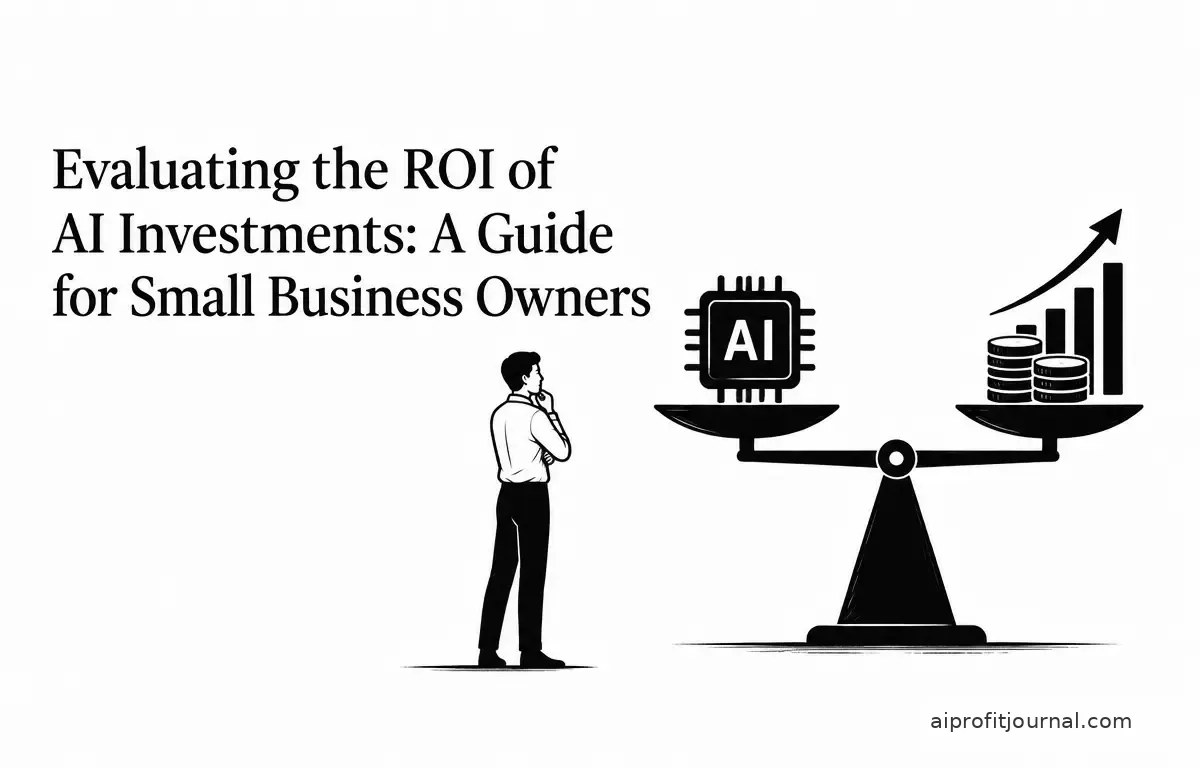
ROI measures the profitability of an investment relative to its cost. In the realm of AI, calculating ROI involves comparing the financial benefits derived from AI implementation against the total costs incurred. These benefits can manifest as increased revenue, cost savings, or enhanced operational efficiency. Accurately measuring ROI is crucial for small businesses to justify AI expenditures and make informed decisions about future investments.
Key Steps to Evaluate AI Investment ROI
1. Define Clear Objectives and Baselines
Before implementing AI, establish specific goals that align with your business strategies, such as:
- Reducing operational costs
- Improving customer service
- Increasing sales or customer engagement
Setting a baseline for current performance metrics allows for a meaningful comparison post-implementation. For instance, if a business aims to reduce customer response time, recording the current average response time provides a reference point to measure improvements.
2. Calculate Total Costs Involved
Consider all expenses associated with AI adoption, including:
- Software and Hardware Costs: Expenses for AI tools, platforms, and necessary infrastructure upgrades.
- Implementation Costs: Costs related to system integration, data migration, and customization.
- Training and Support: Expenses for employee training and ongoing technical support.
- Maintenance Costs: Ongoing costs for system updates, monitoring, and troubleshooting.
By accounting for these costs, you ensure a comprehensive understanding of the financial commitment involved in AI adoption. It may also be useful to create a spreadsheet to track these costs over time, making it easier to revisit and revise your calculations as needed.
3. Measure Quantifiable Benefits
Identify and measure tangible benefits resulting from AI implementation, focusing on metrics that can be directly linked to your objectives:
- Time Savings: Reduction in time spent on manual tasks, leading to increased productivity.
- Cost Savings: Decrease in operational expenses due to automation and optimized processes.
- Revenue Growth: Increase in sales attributed to enhanced customer engagement or improved product offerings.
A hypothetical scenario could involve a small business that automates its customer service with an AI chatbot. If this implementation leads to a 70% reduction in customer support emails, it might save significant operational hours that can be redirected toward more strategic initiatives.
4. Calculate ROI Using the Formula
Once you have all your data, use the following formula to calculate your ROI:
ROI = (Net Profit from AI Implementation - Total AI Investment) / Total AI Investment × 100Net Profit from AI Implementation is derived as follows:
Net Profit = (Quantifiable Benefits) - (Total Costs)Applying this formula provides a percentage that represents your ROI for the AI investment. A positive ROI indicates that the benefits outweigh the costs, justifying the investment. For clearer analysis, consider categorizing benefits under short-term and long-term gains. Short-term might include immediate cost savings, while long-term could involve sustained revenue growth beyond the initial year.
5. Conduct a Sensitivity Analysis
Assess how changes in key variables affect ROI. For instance, analyze how variations in customer response time or support email volume impact the overall ROI. This analysis will help you understand the robustness of the investment and prepare the business for potential fluctuations in performance metrics.
A sensitivity analysis might involve recalibrating your expected outcomes based on best-case, worst-case, and likely scenarios. This can protect against overestimating ROI while also helping you make contingency plans. Additionally, consider the impact of external factors, such as market conditions or economic changes, which may influence your ROI outcomes.
Real-World Examples of AI ROI in Small Businesses
Examining case studies can provide valuable insights into the potential ROI of AI investments for small businesses:
Case Study 1: AI-Powered Customer Support Chatbot
A small e-commerce company implemented an AI chatbot to handle customer inquiries. Prior to implementation, the average response time was 24 hours, which led to customer dissatisfaction and lost sales. After implementing the chatbot, the response time decreased to under 5 minutes. This improvement resulted in a 25% increase in customer satisfaction and a 15% boost in sales. Let’s break down the numbers:
Total Investment: $10,000
Increased Sales: $15,000
Net Profit = ($15,000 increased sales) - ($10,000 investment) = $5,000
ROI = ($5,000 / $10,000) × 100 = 50%
This example demonstrates a positive ROI, indicating that the AI investment was worthwhile. Furthermore, this small business was able to leverage customer insights gained from the chatbot interactions to enhance their overall marketing strategy, achieving additional indirect benefits.
Case Study 2: AI-Driven Inventory Management
A local retail store adopted an AI system to optimize inventory levels and reduce waste. Before adopting AI, the store experienced a 20% loss due to overstocking and stockouts. After implementing AI, losses decreased to 5%, resulting in significant cost savings. Here’s how it breaks down:
Total Investment: $8,000
Cost Savings: $12,000
Net Profit = ($12,000 savings) - ($8,000 investment) = $4,000
ROI = ($4,000 / $8,000) × 100 = 50%
This case illustrates how AI can lead to substantial cost savings and a positive ROI for small businesses. Additionally, improved inventory management allowed the business to enhance customer satisfaction by consistently maintaining product availability.
Key Considerations and Limitations
While AI offers promising opportunities, small business owners should be aware of potential challenges:
- Implementation Complexity: Integrating AI systems may require technical expertise and could disrupt existing workflows temporarily. Plan for these disruptions and consider seeking external help if necessary. A phased implementation strategy may mitigate risks by gradually introducing AI solutions.
- Data Quality: AI systems rely heavily on high-quality data; poor data can lead to inaccurate results and reduced ROI. Regular audits of data quality can ensure the effectiveness of your AI tools. Establish data governance policies to maintain consistency and reliability.
- Ongoing Costs: Maintenance, updates, and potential scaling of AI systems can incur additional costs over time. Budgeting for these potential expenses is crucial for a realistic ROI calculation. Consider allocating a percentage of operational budgets specifically for continuous AI enhancements.
- Change Management: Employees may resist AI adoption; effective training and communication are essential to ensure smooth integration. Engage employees early in the process to foster buy-in and ease concerns. Regular feedback sessions can also help identify areas where employees feel lost or unsupported.
Addressing these considerations proactively can enhance the likelihood of achieving a positive ROI from AI investments.
Conclusion
Assessing the ROI of AI investments is a critical step for small business owners to ensure that their expenditures lead to tangible benefits. By defining clear objectives, calculating total costs, measuring quantifiable benefits, and conducting thorough analyses, businesses can make informed decisions about AI adoption. Real-world examples demonstrate that with careful planning and execution, AI can deliver substantial returns, enhancing operational efficiency and driving growth.
Frequently Asked Questions (FAQs)
What types of AI applications can small businesses utilize?
Small businesses can benefit from AI applications such as chatbots for customer service, predictive analytics for inventory management, automation tools for marketing, and personalized customer experiences to enhance engagement.
How long does it take to see an ROI from AI investments?
The timeline to see ROI from AI investments can vary significantly based on the complexity of implementation and the specific use case. Businesses might see immediate benefits, as in customer service improvements, or longer-term returns from changes in processes. Regularly reviewing and adjusting goals can aid in tracking progress effectively.
Related Articles