Starting a freelance business used to feel like something you needed years of experience for.
You needed a portfolio.
You needed professional writing or design skills.
You needed to know how to find clients.
And, ideally, you needed someone willing to give you your first opportunity.
AI has changed part of that equation.
Not because AI can magically turn a complete beginner into an expert.
It can’t.
But tools like ChatGPT can help you research, brainstorm, create drafts, organize your workflow, write proposals, and learn unfamiliar tasks much faster.
That makes freelancing more accessible than it was before.
The important part is understanding what AI should actually do for you.
AI should help you deliver a service. It shouldn’t be the service.
In this guide, I’ll show you how to start an AI-assisted freelance business from scratch, even if you don’t have previous freelance experience.
I’ll also explain which services are easiest to start with, how to create your first offer, where to find potential clients, and the mistakes that can waste weeks of your time.
Quick reality check: You don’t need years of experience to start freelancing. But you do need to learn enough about the service you’re selling to check AI’s work, fix mistakes, and deliver something genuinely useful.
Can You Really Start Freelancing With No Experience?
Yes, but there’s an important distinction.
You can start without previous freelance experience.
That doesn’t mean you can sell a complicated professional service without learning anything first.
For example, you probably shouldn’t advertise yourself as an expert SEO consultant on day one if you don’t understand SEO.
The better approach is to start with a simple service where AI can reduce the amount of time required to learn and produce the work.
Think of the process like this:
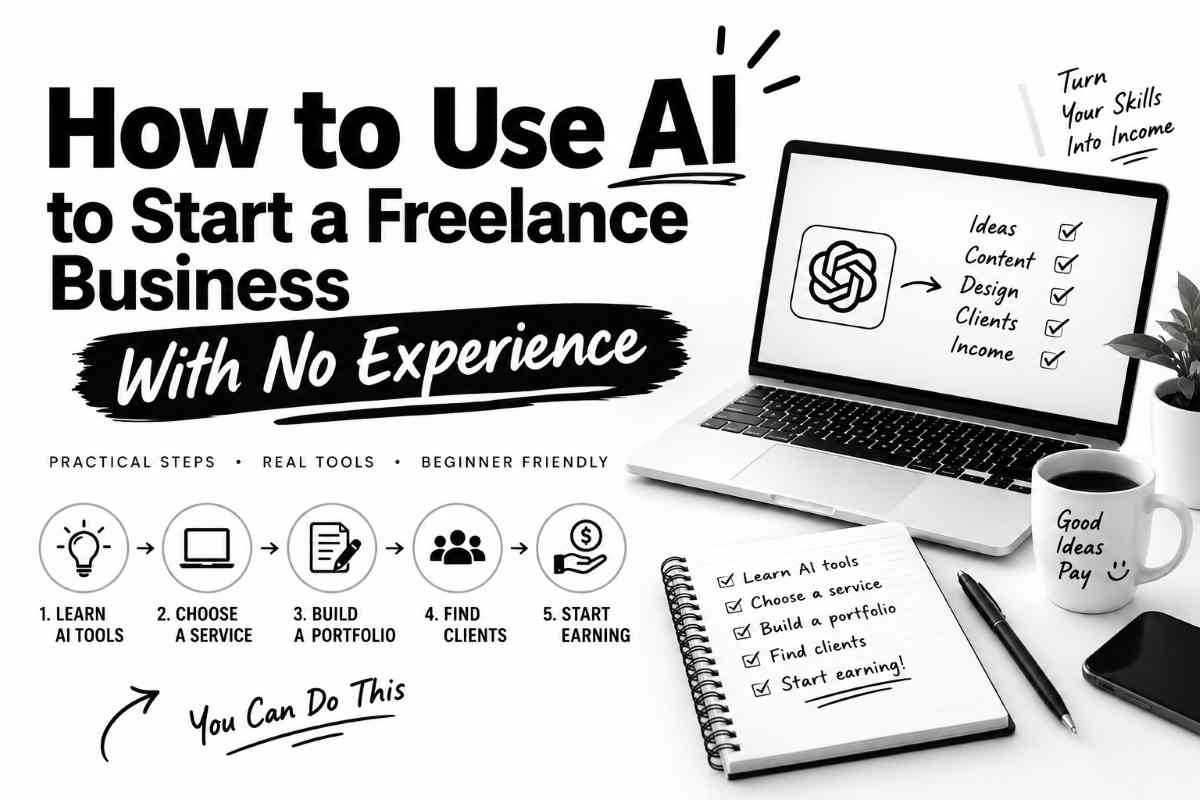
Learn → Practice → Create samples → Offer a simple service → Get feedback → Improve
AI makes the first few steps faster.
It doesn’t remove them.
This is also why I don’t recommend starting with the goal of making “$10,000 per month with AI.”
Start with something much smaller:
Get one person to pay you for one useful result.
That first transaction teaches you more than another 50 YouTube videos about AI side hustles.
Why Freelancing Is One of the Easiest AI Businesses to Start
There are dozens of ways to use AI to make money online.
You can build a blog, sell digital products, create videos, experiment with affiliate marketing, or offer freelance services.
The problem with many of those models is that they require an audience.
Freelancing doesn’t necessarily require one.
You can find a person or business that already has a problem and offer to solve it.
For example:
- A local business needs social media posts.
- An online store needs product descriptions.
- A blogger needs help researching articles.
- A YouTuber needs video scripts.
- A small company needs email copy.
- A creator needs content ideas.
You don’t need thousands of followers to get started.
You need a useful offer and a way to put that offer in front of potential clients.
That’s one reason service-based work is often a more realistic starting point for beginners than trying to build “passive income” immediately.
I’ve written more about this distinction in How to Make Money with AI in 2026.
Step 1: Choose One Freelance Service
This is where most beginners make their first mistake.
They decide to become an:
AI writer + graphic designer + video editor + SEO expert + social media manager + automation consultant
…all at the same time.
Don’t.
Pick one service.
Your first service doesn’t need to be your forever business.
It simply needs to be something you can learn, practice, and sell.
Here are some beginner-friendly options.
1. AI-Assisted Content Writing
You can help businesses or websites create:
- Blog posts
- Product descriptions
- Email newsletters
- Website copy
- Articles
- FAQ pages
AI can help with research, outlines, brainstorming, and first drafts.
Your job is to turn that material into something accurate, useful, readable, and appropriate for the client.
2. Social Media Content
Small businesses often struggle to consistently publish content.
You could offer:
- Instagram captions
- Facebook posts
- LinkedIn posts
- Content calendars
- Post ideas
- Short-form video scripts
AI is particularly useful for generating variations and brainstorming ideas.
But don’t simply ask ChatGPT:
“Give me 30 Instagram posts.”
That’s how you end up with 30 generic posts that sound like every other AI-generated account.
Instead, give AI information about the business, audience, tone, products, competitors, and goals.
The better the input, the more useful the output becomes.
3. Product Descriptions
Ecommerce businesses can have hundreds of products.
Writing descriptions for every product takes time.
You can offer to help create or improve:
- Product titles
- Product descriptions
- Bullet points
- Short marketing copy
- Meta descriptions
This can be a particularly simple service because the work is relatively structured.
4. AI-Assisted Research
Research is another interesting beginner service.
You could help with:
- Competitor research
- Topic research
- Content research
- Market research
- Lead research
- Research summaries
The important word here is assisted.
AI can make research faster, but you still need to verify important information.
Never assume an AI-generated fact is automatically correct.
5. Short-Form Video Scripts
Creators and small businesses need a constant supply of content ideas.
You can offer:
- TikTok scripts
- YouTube Shorts scripts
- Instagram Reels scripts
- Hooks
- Video outlines
A simple offer might be:
“I will create 10 short-form video scripts based on your niche and target audience.”
That’s much easier to understand than:
“I provide AI-powered content solutions.”
Specific beats clever.
Step 2: Learn Enough to Deliver the Service
You don’t need to spend six months studying before finding your first client.
But don’t skip learning entirely.
A simple rule is:
You should know enough to recognize bad work.
If you’re selling blog writing, learn basic:
- Search intent
- Article structure
- Fact checking
- Readability
- Internal linking
- Basic SEO
If you’re selling social media content, understand:
- Hooks
- Audience targeting
- Calls to action
- Brand voice
- Platform differences
If you’re selling product descriptions, understand:
- Benefits vs. features
- Customer objections
- Product positioning
- Clear calls to action
AI can accelerate your learning process.
For example, you can ask ChatGPT to explain a concept, provide examples, quiz you, or critique your work.
But don’t let AI become a substitute for understanding the service.
That’s a dangerous shortcut.
Step 3: Use AI to Build Your First Portfolio
Here’s the awkward part of starting freelancing:
Clients want to see your work.
But you don’t have clients.
So create your own samples.
You don’t need to pretend they’re client projects.
Instead, create spec work.
For example, if you want to offer social media content to restaurants, choose a real restaurant and create:
- 5 sample posts
- 5 hooks
- 3 promotional ideas
- A one-week content calendar
Clearly label the work as a sample.
If you want to offer blog writing, create two or three strong articles around a specific niche.
If you want to offer product descriptions, take three fictional products and create before-and-after examples.
Your portfolio doesn’t need 30 samples.
I’d rather see three excellent examples than 25 mediocre AI-generated pieces.
Step 4: Create a Simple Freelance Offer
Don’t make your offer complicated.
A good beginner offer answers three questions:
What do you do?
Who do you do it for?
What result do they get?
For example:
I help small ecommerce businesses create clear, SEO-friendly product descriptions so they can publish products faster.
That’s much better than:
I use cutting-edge AI technology to transform your digital presence.
Nobody knows what that means.
Your first offer should be boringly clear.
Step 5: Create a Simple Package
You don’t need ten pricing tiers.
Start with one small package.
For example:
Starter Content Package
5 social media posts
Includes:
- 5 captions
- 5 content ideas
- Basic calls to action
- One revision
Or:
Blog Starter Package
1 SEO-focused article
Includes:
- Topic research
- Outline
- Draft
- Manual editing
- Basic on-page SEO
- One revision
The goal isn’t to maximize the price immediately.
The goal is to make the first purchase easy.
Once you’ve completed several projects and understand your process, you can increase your pricing.
Step 6: Find Your First Potential Clients
This is where freelancing becomes a business.
You need people to know your service exists.
There are several places you can look.
Freelance marketplaces
Platforms such as Fiverr and Upwork can help beginners find existing demand.
The downside is competition.
You’re not the only person offering writing, design, or social media services.
That’s why your offer needs to be specific.
Instead of:
“I will write articles.”
Try:
“I will write beginner-friendly fitness articles for health websites.”
The second offer immediately tells a potential client whether you’re relevant.
Direct outreach
You can also contact businesses directly.
Look for businesses that clearly have a problem you can solve.
For example:
A restaurant has an inactive Instagram account.
An ecommerce store has weak product descriptions.
A local company hasn’t updated its blog in months.
A creator posts videos but struggles to publish consistently.
Don’t send:
“Hi, I offer AI services. Do you need help?”
That’s easy to ignore.
Instead, identify something specific.
For example:
“I noticed your last few product pages don’t have short benefit-focused descriptions. I put together a sample rewrite for one of your products.”
You’re demonstrating value instead of simply asking for money.
Step 7: Use AI to Speed Up Your Workflow
This is where AI becomes genuinely useful.
Let’s say a client orders a 1,500-word article.
Without AI, you might spend hours researching, outlining, drafting, and revising.
With AI, you can speed up several parts of the process.
A simple workflow might look like this:
Research
Use AI to brainstorm:
- Questions readers might have
- Subtopics
- Angles
- Potential objections
Then verify important information using reliable sources.
Outline
Ask AI to create several possible structures.
Choose the strongest one yourself.
First draft
Use AI to help create an initial draft.
Don’t publish it immediately.
Editing
This is the important part.
Read the entire piece.
Fix:
- Repetitive language
- Incorrect claims
- Generic statements
- Awkward sentences
- Unsupported information
- Overused transitions
- Robotic phrasing
Then add your own examples, observations, and judgment.
Final quality check
Read it as if you’re the client.
Would you actually pay for this?
If the answer is no, keep working.
Step 8: Don’t Hide Behind AI
This might sound strange on a website about making money with AI, but it’s important.
You don’t need to tell every client:
“AI created this.”
But you also shouldn’t misrepresent your expertise or deliver unchecked AI output as professional work.
The value isn’t the button you press.
The value is the finished result.
Imagine a client pays you $50 for an article.
They don’t care that you spent 20 minutes generating a draft.
They care whether the article:
- Makes sense
- Is accurate
- Sounds natural
- Fits their audience
- Solves their problem
- Is ready to publish
That’s what they’re buying.
AI is your production tool. The outcome is your product.
Step 9: Send Better Proposals
Your first proposals will probably get ignored.
That’s normal.
Don’t interpret rejection as proof that freelancing doesn’t work.
Improve the pitch.
A simple proposal structure is:
1. Show that you read the request
Mention something specific.
2. Explain how you would approach it
Keep it short.
3. Show relevant work
Link to one or two samples.
4. Make the next step easy
Offer a small starting project.
Avoid writing an essay about yourself.
The client isn’t primarily interested in your life story.
They’re interested in whether you can solve their problem.
Step 10: Get Your First Client Before You Build a “Business”
This is another trap beginners fall into.
They spend three weeks building:
- A logo
- A fancy website
- Business cards
- A complicated portfolio
- A 12-page business plan
And still haven’t contacted a single potential client.
You don’t need all of that initially.
Your first version can be:
One service + three samples + one simple offer + a way to contact you.
That’s enough to test demand.
If people respond, improve the business.
If nobody responds, change the offer.
Don’t spend months polishing something nobody wants.
How Much Can a Beginner Actually Charge?
There’s no universal beginner price.
Your price depends on:
- The service
- Quality
- Niche
- Scope
- Client location
- Turnaround time
- Your portfolio
- Demand
Don’t obsess over finding the “perfect” number.
Instead, start with a small project that lets you prove your ability.
For example, rather than trying to sell a $1,000 monthly package immediately, you might begin with a small fixed project.
Once you’ve delivered successful work, you have something much more valuable than a certificate:
proof that someone was willing to pay you.
Then you can gradually increase:
- Project size
- Pricing
- Retainers
- Service complexity
A Simple 7-Day Plan
If you’re starting from zero, here’s how I’d approach the first week.
Day 1: Pick one service
Choose something simple.
Don’t spend the entire day researching 50 AI business ideas.
Pick one.
Day 2: Learn the basics
Spend a few hours learning what good work looks like.
Study examples.
Analyze competitors.
Practice.
Day 3: Create sample #1
Make your strongest portfolio piece.
Don’t rush it.
Day 4: Create samples #2 and #3
Now you have something to show potential clients.
Day 5: Create your offer
Write down:
- Who you help
- What you provide
- What the client receives
- How long it takes
- Your starting price
Keep it simple.
Day 6: Find potential clients
Build a list of businesses or creators that could genuinely benefit from your service.
Quality matters more than having a massive list.
Day 7: Start outreach
Send personalized proposals or messages.
Don’t expect every person to respond.
Your goal during the first week isn’t necessarily to make a lot of money.
It’s to start the feedback loop.
Offer → Response → Improve → Offer again.
That’s how the business gets better.
What I Would NOT Do as a Beginner
After looking at different AI income experiments, there are a few patterns I keep coming back to.
The biggest mistake is trying to automate everything before you have something people actually want.
I would avoid:
❌ Offering 10 services at once
You’ll become mediocre at everything.
❌ Copy-pasting AI output
Clients can tell.
Even when they can’t immediately tell, poor work eventually catches up with you.
❌ Competing only on price
Being the cheapest freelancer is not a great long-term strategy.
❌ Buying expensive AI tools immediately
You probably don’t need a huge software stack.
Start with a small number of tools and learn how to use them well.
❌ Waiting until everything is perfect
Your first offer will probably be bad.
That’s okay.
You improve it through actual feedback.
The AI Freelancing Stack I’d Start With
You can keep your initial setup surprisingly simple.
ChatGPT
Use it for:
- Brainstorming
- Research assistance
- Outlines
- Drafting
- Editing
- Client communication
- Learning
Canva
Useful for:
- Social media graphics
- Simple presentations
- Portfolio pieces
- Content templates
A freelance marketplace
Use platforms such as Fiverr or Upwork to test demand.
Google Docs or another writing workspace
Keep client projects organized and easy to review.
You don’t need 15 AI tools.
In fact, having too many tools can become another form of procrastination.
For a broader look at the tools worth considering, see our guide to the best AI tools to make money online.
What Makes an AI Freelancer Valuable?
Here’s the part I think gets missed in most “make money with AI” content.
The valuable skill isn’t knowing how to type a clever prompt.
It’s knowing what to do after AI gives you an answer.
A good freelancer can:
- Spot bad information
- Improve weak writing
- Understand a client’s goal
- Ask better questions
- Make decisions
- Add context
- Communicate clearly
- Deliver consistently
That’s why I think the future of AI freelancing isn’t simply:
Humans vs. AI
It’s more like:
People who know how to use AI effectively vs. people who don’t.
The tool becomes widely available.
The judgment remains valuable.
A More Realistic Way to Think About Your First $100
Don’t make your first goal “$10,000/month.”
Make it:
$10.
Then:
$50.
Then:
$100.
Why?
Because each small payment proves something.
The first $10 proves someone is willing to exchange money for your work.
The next $50 gives you more confidence and experience.
The first $100 starts showing you which services people actually want.
This is also consistent with the broader experiment documented here at AIProfitJournal, where a beginner-focused AI income experiment reached $104 by combining freelance work, digital products, and social media services. The interesting lesson wasn’t the $104 itself—it was that simple service work produced results faster than more passive approaches. Read the full $0 to $100 AI case study.
The Biggest Lesson
AI makes it easier to start.
It doesn’t make freelancing effortless.
You’ll still experience:
- Ignored messages
- Rejected proposals
- Difficult clients
- Revisions
- Slow weeks
- Work that takes longer than expected
That’s normal.
The advantage is that AI can reduce the amount of time you spend on repetitive parts of the job.
That gives you more time to focus on what actually creates value:
understanding the problem and producing a good solution.
If you approach AI freelancing that way, you have a much better chance of building something sustainable.
Final Thoughts
You don’t need to be an expert to start a freelance business.
You don’t need a huge audience.
You don’t need a complicated website.
And you definitely don’t need 30 AI subscriptions.
Start with one service.
Learn it.
Use AI to accelerate the work.
Create three strong samples.
Find people who need the service.
Make a simple offer.
Then keep improving based on real feedback.
The goal isn’t to build a “fully automated AI business.”
The goal is much simpler:
Become useful to someone, and use AI to become more efficient at delivering that usefulness.
That’s a much more boring strategy than the “$10,000 in 7 days” videos.
It’s also a lot more realistic.
FAQs
Can I start freelancing with AI if I have no experience?
Yes. You can start without previous freelance experience, but you should still learn the basics of the service you’re selling. AI can help you learn and work faster, but you remain responsible for the quality of the final result.
What is the easiest freelance service to start with AI?
AI-assisted content writing, social media content, product descriptions, research assistance, and short-form video scripts are relatively accessible starting points. Choose one service rather than trying to offer everything at once.
Do I need to know how to code?
No. Many beginner-friendly freelance services involving AI don’t require coding. Writing, research, social media content, design, and administrative services can all be supported by AI without programming.
Can I use ChatGPT to do freelance work?
Yes. ChatGPT can assist with research, brainstorming, outlining, drafting, editing, and many other tasks. However, you should review and improve its output rather than sending raw AI-generated material directly to clients.
How do I get my first freelance client?
Start by creating a few strong samples, then approach potential clients through freelance marketplaces or direct outreach. A specific offer that solves a clear problem is usually more effective than a generic “AI services” pitch.
How much should a beginner charge?
There is no single correct beginner rate. Start with a small, clearly defined project and price it according to the scope, quality, niche, and market. After gaining experience and client results, you can increase your rates.
Is AI freelancing still worth starting in 2026?
It can be, but the opportunity isn’t simply “using AI.” Competition is increasing, so freelancers who combine AI with real skills, niche knowledge, quality control, and good communication have a stronger advantage.
Will AI replace freelance writers and designers?
AI is already changing freelance work, especially repetitive tasks. But clients still need people who understand their goals, make decisions, check quality, and turn raw AI output into useful finished work. Freelancers who learn to work effectively with AI may have an advantage over those who ignore it.
Can I make a full-time income from AI freelancing?
It’s possible, but there’s no guaranteed income level or timeline. Most beginners should focus first on proving that people will pay for their service, then gradually increase their workload, pricing, and client base.
What’s the biggest mistake beginners make with AI freelancing?
Trying to sell AI itself instead of selling a useful outcome. Clients generally care about what gets done for them, not which AI tool you used to do it.
Related Reading
- How to Make Money with AI in 2026: Beginner Guide
- I Tried Making Money with ChatGPT for 7 Days: Real Results & Lessons
- From $0 to $100 Using AI: Full Beginner Case Study
- I Tested 5 AI Side Hustles for 30 Days: Here’s What Actually Paid
- Best AI Tools to Make Money Online
- 7 AI Side Hustles That Actually Work